

Inhaltsverzeichnis
Verwandte Nachrichten

Which Industrial Rain Gear Fits Each Job?

An industrial rainwear order is specified from the shift the garment has to survive and from the document the tender requires. A crew that kneels in mud for a full shift, and a driver who leaves and re-enters a vehicle through the day, place different requirements on cut, weight and seams. An enquiry that states only that the clothing is for rain leaves those requirements blank. The garments are then replaced and shipped again at full freight.
Construction, cut and the size run stay open until the enquiry carries three records: shift length and the movements repeated; abrasion, contamination and the cleaning chemical; and the standard or report named in the tender. Quotations from Chenyuan Regenausrüstung are prepared against those records.
Operating Records That Fix the Specification
Shift duration and range of movement
Record the hours spent outdoors, and state whether the wearer kneels, climbs, lifts or remains standing. Those two records remove unsuitable constructions before a sample is cut. Record weight on the same line. CY028 is listed at 660 g, DW08 at 1,000 g and CY106 at 1,450 g. Each figure is the load of that model for the length of the shift. Keep each figure with its own model.
Where the shift includes cold mornings, the wear trial includes the required movement at the site temperature. Approval in a heated sample room does not show whether the wearer can still kneel, climb or enter a vehicle.
Abrasion, contamination and the cleaning chemical
State contact by body zone. On a construction site the garment meets tool belts at the waist, scaffold tube at the shoulder and the side, and wet concrete or gravel at the knee and the shin. On a sanitation route it meets bins at the hip and the thigh. Name the zone on the specification.
The cleaning chemical is a separate line. Fish oil, chlorinated cleaners and quaternary disinfectants act on coatings at different rates. Write the chemical the crew uses, and soak a swatch of the proposed coating for one week before bulk approval. Include the storage the crew uses. A wet garment left in a toolbox allows seam tape to degrade and a coating to crack. The trial then runs the employer’s laundry cycle.
The document the tender names
Where a tender names ANSI/ISEA 107 or EN ISO 20471, buy against the report for that class, that model and that material, and confirm that its scope covers the order. The class is on the sewn-in label and in the report. Colour, including blaze orange, is recorded on its own. ISO 9001, CE, BSCI and REACH, where they are printed on a product page, are not that report.
Flame-resistant, arc-rated and chemical-protective requirements, including ASTM F1891 or NFPA 70E, remain separate garments and separate reports. For sustained rainfall, specify waterproof construction and the seam finish. A water-resistant finish can wet through under heavy rain. Where a product page uses both terms, approve from the sample and the report.
Construction Assigned to the Work Environment
Construction, roadwork and utility crews
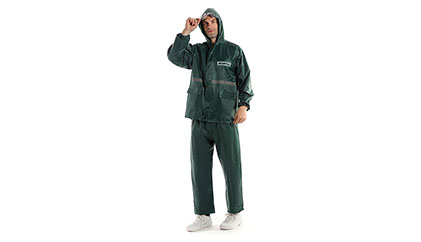
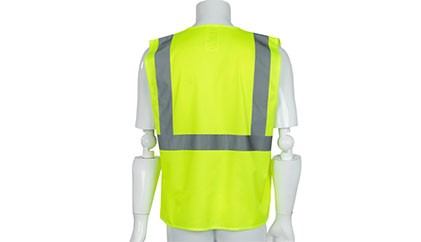
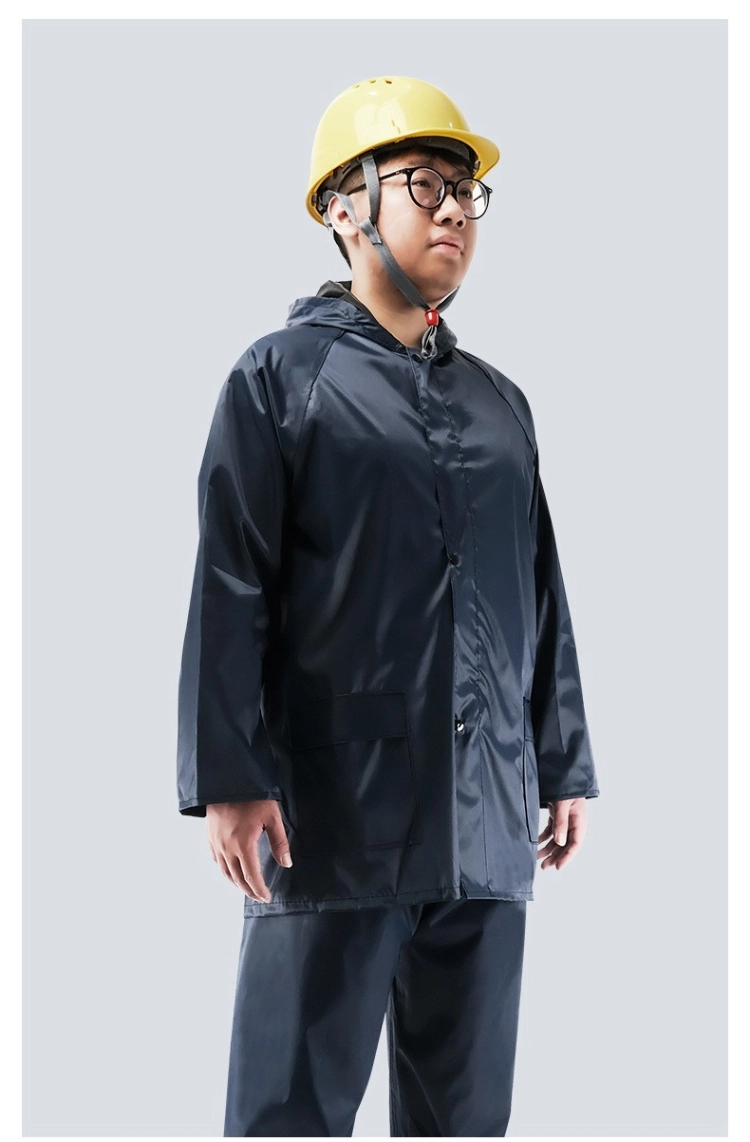
Scraping is the condition that selects the fabric for these crews. The CY066 Oxford PVC rainsuit is 150D Oxford with a 0.20 mm PVC coating, listed in navy blue, with a reflective strip across the back. The strip is specified where visibility at dusk is required. Where the tender names a high-visibility class, obtain the report for the garment being offered before CY066 is entered on the bid.
CY066 is offered in one size. The published measurements are a coat length of 80 cm, a sleeve of 75 cm, a chest circumference of 62 cm and a trouser length of 98 cm. Compare those four figures with the smallest and the largest workers on the roster before committing to the minimum of 900 sets. Packing is one set per bag and 20 sets per carton. Production for this model is usually 35 to 40 days. The same page gives the weight as 1,000 g and the single-package gross weight as 900 g. Confirm which figure is the shipped set before CY066 is compared with another model on weight.
Before the sample is cut, the tech pack states two further items. Bib trousers are specified for digging, where an elastic waist can work down. Line workers require a shorter hem for ladder rungs and a hood cut clear of the hard hat in use. State that clearance on the tech pack. Record the service interval required under rebar and scaffold contact, and confirm it on the wear trial.
Yards, warehouses and sanitation routes
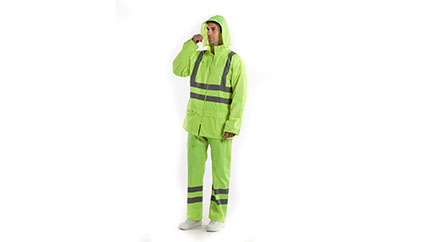
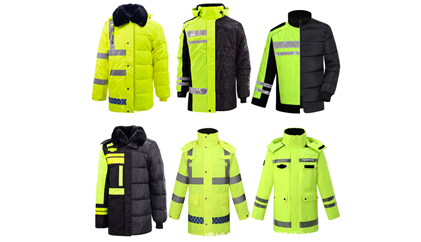
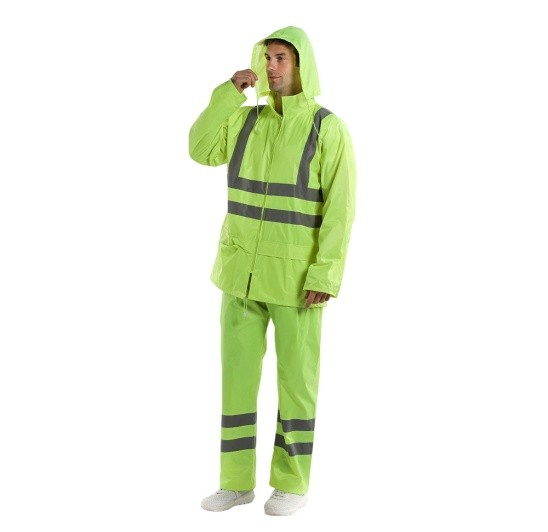
Repeated entry and exit from a vehicle changes the cut. An ankle-length coat catches on the steps when the wearer climbs in and out through the shift. For that pattern of movement, the specification starts with a two-piece suit. The DW08 polyester PVC rainsuit is polyester with a 0.18 mm PVC coating, listed at 1,000 g a set, in sizes S to 3XL, in green or orange. The minimum order is 1,000 sets, packed at 20 sets per carton. The product photograph shows reflective bands on the jacket and on the trousers. Approve colour and band placement on a physical sample. Where the tender names ANSI/ISEA 107 or EN ISO 20471, attach the report for this model and this material.
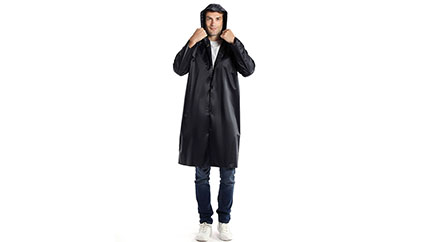
Guards and dispatchers who stand for most of the shift are specified from the long raincoat range. The CY028 long raincoat is 170T polyester with a PVC coating, listed from M to 4XL at 660 g, in navy blue and army green. The minimum order is 2,000 sets, packed at 50 sets per carton. The page title describes a button closure. The product detail describes a zipper together with buttons. Confirm the closure on the sample. The same page uses both “water-resistant” and “waterproof”. The sample, and any report supplied with it, is the record of water performance for this model.
A kneeling crew and a driving crew are two lines on one purchase order. Each line keeps its own model, its own minimum order quantity and its own size run.
Fishing decks and wash-down areas
A working deck combines salt spray, fish oil, netting and steel rails, and a wash-down plant runs hoses for the full shift. Specify a PVC bib and a PVC jacket, the cleaner in use, and a swatch soaked for one week. Under continuous spray the coating has to survive the chemical. Select the construction from the Regenanzugkategorie against that specification.
Thickness, Weight and Seams on the Quotation
Compare thickness and weight inside one construction
DW08 is coated at 0.18 mm PVC on polyester, CY066 at 0.20 mm PVC on Oxford, and CY106 at 0.40 mm PU. These thicknesses are compared only when the backing fabric, the coating polymer and the seam construction are the same. The three models differ on backing, polymer and seams, so the comparison is a wear trial with the crew who will wear the order. CY066 remains outside any weight comparison until the shipped weight is confirmed as the stated 1,000 g or the stated single-package gross weight of 900 g.
Specify seams and closures before the sample is cut
On a kneeling shift, leakage is expected first at an untaped seam and at the closures, while the fabric is still intact. Specify sealed seams where kneeling is part of the work. The CY106 sealed PU rainsuit is 0.40 mm PU with fully sealed seams and back vents, in sizes M to 3XL, listed at 1,450 g, in navy blue. The minimum order is 1,000 sets, packed at 20 sets per carton. The page describes snap buttons and also a zipper together with snap buttons. Confirm which closure is manufactured for this order. The sample fee for CY106 is charged and refunded after the order is placed. That refund is stated for this model. Apply it to another model only when that model’s quotation states it.
Approve the zipper or storm flap, the cuffs and the hood opening on the finished sample, where a fabric swatch cannot show them.
Items Locked on the Purchase Order Before Cutting
Size distribution and the measurement basis
Confirm whether the size chart measures the body or the finished garment before any quantity is divided. For CY066, compare the four garment measurements above with the roster. For sized models, take the distribution from the previous season’s issue log, or from a wear trial of about ten wearers where no log exists. Set the quantities from that record.
Rainwear is issued over other work clothes, sometimes over a padded layer. Identify that inner layer in the workwear category before the outer size is chosen. The chart basis, the inner layer and the trial then fix the quantities.
Artwork, labels and carton quantity
Supply the logo as editable artwork. Before cutting, confirm print size, position and method in writing. On CY066, mark the back reflective strip on the artwork so the print stops clear of the strip. A print that crosses the strip is rework after the strip has been applied. On DW08, mark the reflective bands shown on the jacket and the trousers in the same way. Brand text and care text are specified separately for the woven label, the hang tag and the wash label.
Carton quantity is decided with the quotation, because it sets the freight. DW08, CY106 and CY066 are packed at 20 sets per carton. CY028 is packed at 50 sets per carton. State at this stage whether a printed polybag or a header card is required. A packing change after cutting changes the carton count and the schedule.
Sample approval and the reference for repeat orders
Samples for these models are usually available in 7 to 10 days. Issue one sample to one worker for the wet shift this order is specified for, then for the employer’s laundry. Retain the passed sample with the size-chart version and the measurement points used to accept it. Inspect bulk cartons and the next order against that sample.
Chenyuan Raingear has manufactured rainwear in Yiwu since 1992, and cuts, sews and heat-seals seams in its own workshops. Ask the quotation to state the inspection steps for the order, including seam sealing and the finished-garment check, and whether a written report is issued before shipment.
Records to Send with the Enquiry
Both lists go with the request for quotation. A quotation prepared without them has to be reissued once the missing record arrives.
Operating conditions
- Shift hours, and the movements repeated on that shift: kneeling, climbing, lifting or standing.
- Abrasion by zone: tool belts, scaffold, concrete, gravel or bins, as applicable.
- The cleaning chemical, where the crew uses one, and confirmation that a swatch will be soaked for one week.
- Each tender document that names a standard, and the model and material the corresponding report must cover.
Commercial requirements
- Size distribution from the issue log or the wear trial, with the chart identified as a body measurement or a garment measurement.
- Target quantity and colours, and each model on its own line, with that model’s minimum kept separate.
- Artwork with print positions marked, including every reflective strip or band on the selected model.
- Packing: sets per carton, and printed polybags or header cards where required.
- The delivery window the order has to meet.
Schlussfolgerung
An enquiry can be quoted when it names the shift and its movements, the abrasion and the cleaning chemical, and the report the tender requires. The purchase order then fixes the measurement basis, the size distribution, artwork placed clear of any reflective strip or band, the carton quantity, and one sample that has completed that shift in the wet and passed the employer’s laundry. Later cartons and the next order are checked against that sample.
Häufig gestellte Fragen
Q1: Can a kneeling crew and a driver crew be placed on one purchase order?
A1: They can be placed as two lines. Each line keeps its own model and its own minimum. CY066 is 900 sets, DW08 and CY106 are 1,000 sets each, and CY028 is 2,000 sets. The minimums stay with their models.
Q2: A product page lists ISO 9001, CE, BSCI or REACH. Does that meet a tender that names ANSI/ISEA 107 or EN ISO 20471?
A2: No. Those certificates are not the high-visibility report. Attach the report for the named class, issued for the model and the material on the order, and confirm that its scope covers the batch.
Q3: Is the sample fee refunded on every model?
A3: On CY106 the fee is charged and refunded after the order is placed. For CY066, DW08 and CY028, treat a refund as applying only when that model’s quotation states it.
 E-Mail-Adresse
 von Whatsapp
 Nachricht hinterlassen
 oben