

Table of Contents
Related news

PPE Sizing for Work Rainsuit Orders: How Many of Each Size Should You Order?
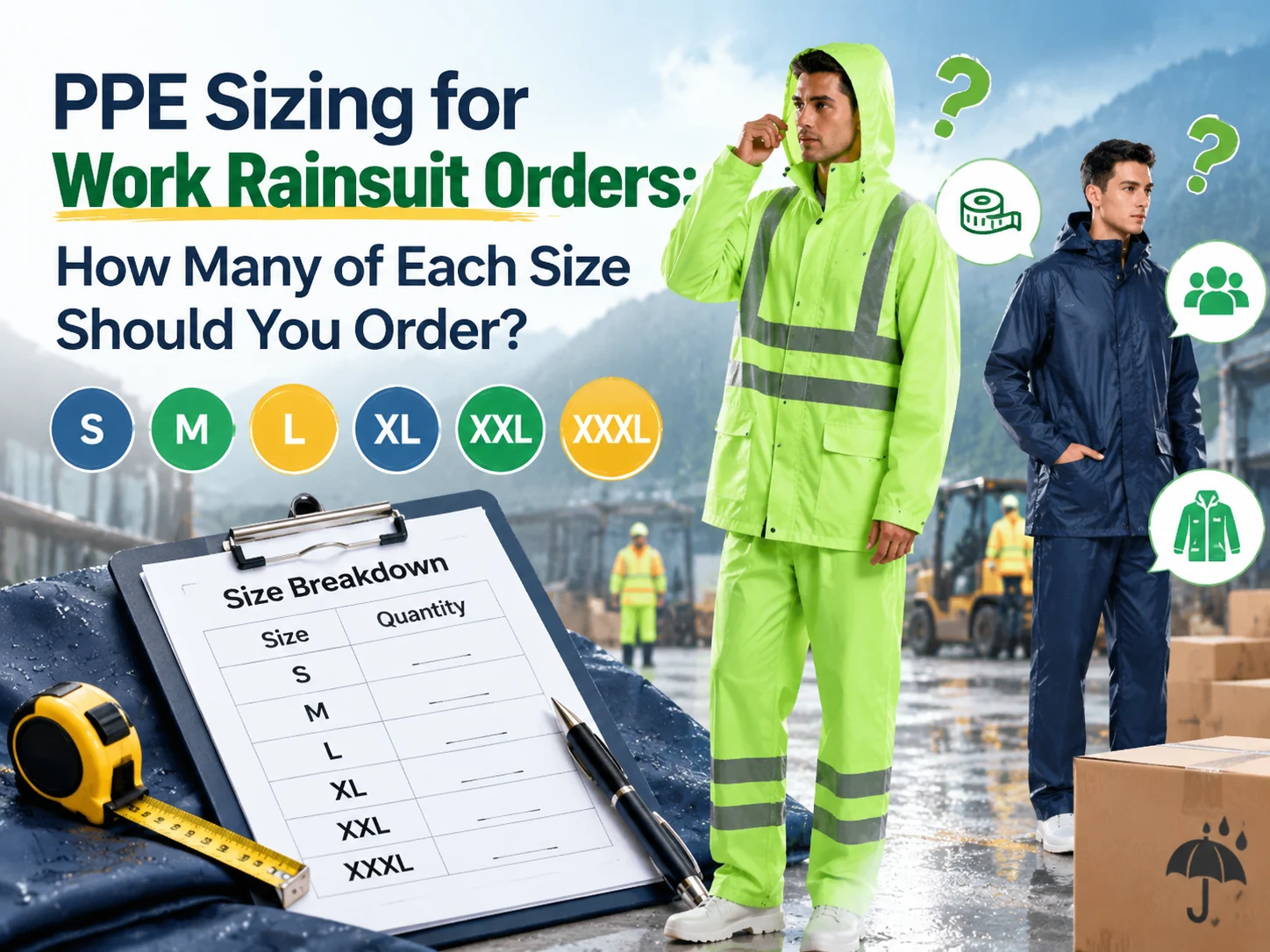
A work rainsuit order leaves with a headcount and a worksite, not a list of body measurements. Someone has to put a number against every size on the purchase order, the factory cuts to that breakdown, and the mismatch surfaces on the first wet shift as a few sets nobody on the crew can pull on over their workwear.
That breakdown is decided by three inputs that rarely arrive together: the size range the chosen model is actually made in, the basis of the size chart being read, and the way measurements step from one size to the next. Together they decide whether the ordered set can be issued as it stands, and whether a repeat order can be compared against the first one.
The Order Commits to Sizes Before the Crew Is Known
What the Buyer Commits To
A bulk rainsuit order buys coverage, not individual fit. The purchase order fixes a size breakdown and a quantity for each size, and the factory cuts to that breakdown; individual fitting happens later, at issue, when a supervisor hands out sets. By then the sizes are already in the cartons.
That changes what the buyer needs to know before ordering. The useful inputs are the crew’s expected spread of chest, waist and inside-leg measurements, the tallest and shortest workers likely to be issued a suit, and the layer each of them will wear underneath. A size breakdown built only from a headcount tends to concentrate in the middle and leave the extremes uncovered, which is exactly where a work suit is hardest to substitute.
Where a Size Set Fails
A size set fails in two ways, and only one of them looks like a sizing error. The obvious failure is a size that runs out while the largest sizes sit unused. The second is subtler: a set that is numerically complete but unusable in practice, because the garment will not close over the workwear the crew actually wears. That is a ppe fit problem rather than a size problem — the label is right, the layer stack is wrong.
Work rainsuits are normally worn as an outer layer over a shirt, work trousers or thermal layers, so the measurement that matters is the one taken over those layers, not over a T-shirt. When a crew works outdoors in winter, the same nominal size can be wearable for one worker and too tight for the next depending on what sits underneath. Deciding this at order stage, rather than at issue, is what keeps the breakdown honest.
What the Supplier’s Size Range Actually Covers
Range Is Model-Specific
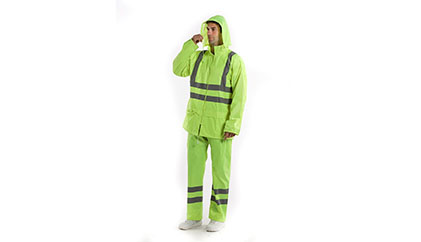
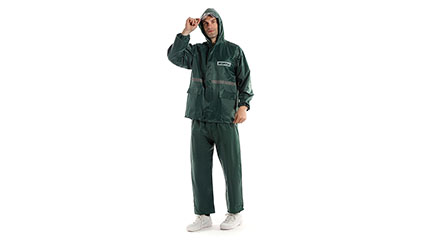
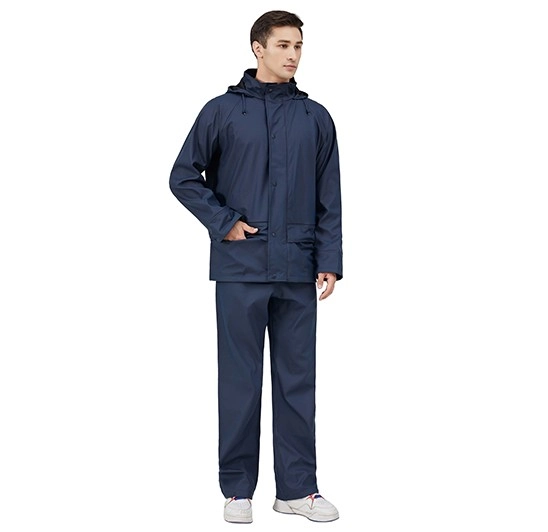
Chenyuan Raingear builds rainwear as a range of models, and each model carries its own size range rather than a company-wide scale. The industrial safety rainsuit with pants is listed in S through XXXL, while the two-piece PU rainsuit is offered in M to 3XL. Both are two-piece work suits, both are quoted at a 1,000-set minimum, and neither tells you what size the next model is made in.
The practical consequence is that a size set cannot be carried over when the style changes. Replacing a previous suit with a new model means re-checking the range before the breakdown is finalised, even when the crew, the worksite and the layer stack are unchanged. Design changes such as length, hood shape or trouser cut can shift the range without appearing in the product name. The current range for each model is published by Chenyuan Raingear with the product description.
What a Custom Size Changes
When the crew needs a size outside the model’s range, the size set stops being a selection and becomes a specification. A made-to-measure size has to be stated with the measurements that matter for that garment — typically chest, waist, inside leg and the sleeve length the work requires — and then confirmed on the sample before the bulk order is cut.
Treat any custom size as a separate item in the breakdown. It has its own measurement basis, its own approval record and its own place in the quantity table, which keeps it from being absorbed into a standard size later. A custom work rainsuit can be built this way, but the measurements have to come from the buyer, because the factory cannot infer them from the crew list.
Read the Size Chart Before Comparing Sizes
Garment Measurement or Body Measurement
A ppe size chart is only useful once you know what each number describes. Some charts list body measurements — what a worker measures around the chest or waist — and others list garment measurements, the dimensions of the finished suit. Comparing a body measurement against a garment measurement is the most common way a breakdown goes wrong, because both columns look like the same figure with a different label.
Garment measurement also carries the allowance built into the pattern. That allowance is what decides whether the jacket closes over a fleece and whether the trousers can be pulled over work boots and a second pair of trousers. When the chart states garment measurements, the buyer should measure a garment the crew already wears, in the same way, and compare like with like.
Sizing Over the Layer the Crew Actually Wears
The layer underneath is part of the size decision, which is why the same worker can wear one size in a summer suit and another in a winter one. Two-piece suits make this harder than a single coat: the jacket has to clear the shoulders and upper arms, and the trousers have to sit at a comfortable height while still covering the waist in a working posture, such as kneeling, climbing or reaching overhead.
Before fixing the breakdown, describe the layer stack that the suit has to go over — the workwear layer underneath, a thermal layer in cold months, and any harness or vest the crew wears. Where a size is chosen at the boundary, state in the order whether it was chosen for the layer stack or for a bare-shirt fit, so the factory quotes against the same assumption.
Sizes Do Not Travel Between Models
How Measurements Step Between Sizes
Size grading describes how each measurement changes as the size increases: the chest may step by a fixed amount while the sleeve length steps by less, and the inside leg may step differently again. Two suits can carry the same size label and grade differently, so the size a worker wears in one model is not automatically the size they wear in the next.
Grading is also where a range shows its limits. A suit made in S to XXXL does not simply repeat the middle-size proportions at both ends; the extremes are usually the first to expose a grading problem, which is why they are worth measuring on a sample instead of reading from the chart alone. For a crew that includes workers at both ends of the range, that check is part of the ordering work, not an extra step.
What to Freeze for a Repeat Order
A repeat order is only comparable if the size basis was recorded the first time. The chart version, the points of measure used, any tolerances agreed with the factory, the measured values of the approved sample per size, and the label mapping all belong in the order file. With those recorded, a second delivery can be measured against the first; without them, the buyer is comparing labels and memory.
Sizes also need a place in the change record. If a measurement is changed after approval, the change shifts every size on the graded scale, not only the one size measured. Recording the change against the size set keeps the approved version and the revised version distinguishable, which matters when the next order is placed against the old file.
Verify the Size Set on the Sample and in the Batch
Approve the Sizes That Decide the Set
Sampling is usually treated as a colour and construction check, but it is also the only chance to measure the graded scale before production. Approve at least the smallest and largest sizes planned for the order, plus the size carrying the largest quantity, and measure them at the same points of measure the chart uses. If the extremes deviate, the middle of the range will almost certainly need attention too.
Measurements should be recorded per size with the date and the garment identity, so the approval refers to a size set rather than a single garment. Where a measurement falls outside an agreed tolerance, deciding whether to adjust the grade or the tolerance is a buyer decision, and it is cheaper to take it at sampling than after the cartons are packed.
Keep Size Checks in the Inspection Record
Size and label checks belong in the production inspection as well as in the buyer’s file. Incoming material, in-process assembly and the finished garment are inspected in sequence, and every finished item is checked before packing; size and label conformity is one of the points that has to be verified there. A size deviation caught in process can be corrected within the batch; the same deviation found after packing becomes a sorting problem.
For a buyer, the value of the record is cumulative. Repeated size complaints from one model, or a label mismatch that appears twice in the same run, point to a specification or grading issue rather than isolated pieces, and they give the next order something specific to correct.
Conclusion
The size set is the part of a rainsuit order that is committed before the crew is known, and it holds only when it is built from three things: the range the chosen model is actually made in, the basis of the chart being read, and the way measurements step between sizes. Those three are also what make a repeat order checkable, because they turn a size label into a measurement with a version behind it.
Bring the planned breakdown — sizes, quantities, and the layer each worker wears underneath — to the quotation, and confirm which of those sizes the model is actually made in, and whether any of them has to be specified as a custom size, before the sample is cut.
FAQs
Q1: Does the size set have to include every size the model is made in?
A1: No. The set should cover the sizes the crew and the layer stack actually need. Carrying every size in the range ties up stock in sizes nobody is issued, while dropping a size that a few workers need means those workers fall back on a custom size or on a different model.
Q2: Can one chart cover a mixed crew?
A2: Only if the chart and the model are checked against the people being issued the suit. A two-piece range is listed with its own sizing, and the layer worn underneath changes which size a worker needs. Where the crew needs a measurement outside the range, the size has to be specified individually rather than assumed from the nearest label.
Q3: What should be recorded so the next size set is comparable?
A3: The chart version, the points of measure, the agreed tolerances, the measured values of the approved sample for each graded size, and the label mapping used for the order. Those five records let a later delivery be measured against the approved set instead of compared by size label alone.
 E-mail
 Whatsapp
 Leave Message
 top
top