

Table of Contents
Related news
Which China Raincoat Manufacturer Fits Your Bulk Order?
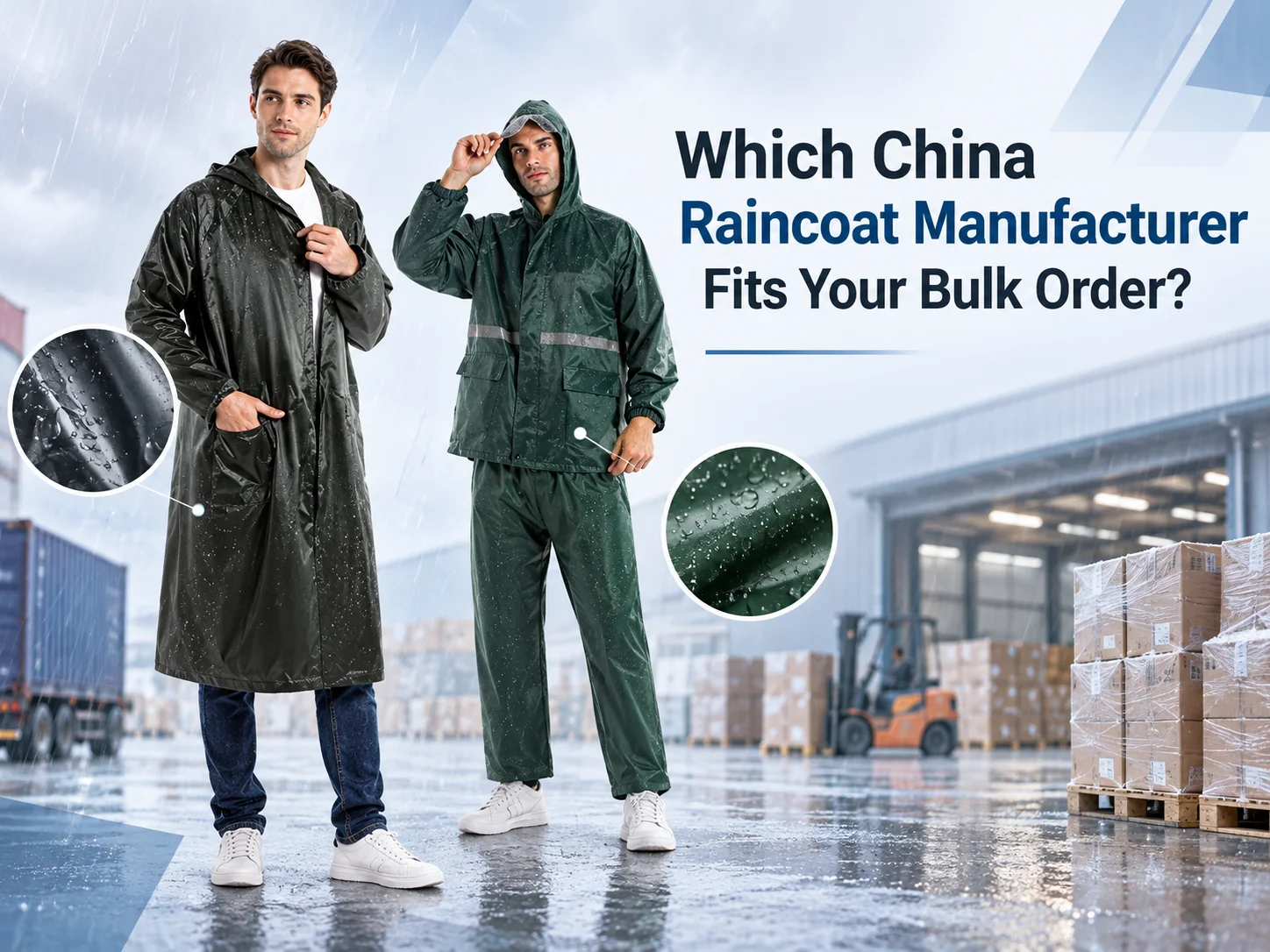
Two raincoats ordered at the same price per piece from the same China raincoat factory can still behave differently after a month on site. One sheds water along the shoulders and seams; the other wets through where the panels meet. That difference rarely comes from the fabric alone. It comes from details nobody wrote down before the order went into production.
The steps below follow the order most buyers work through: what the factory controls, the specification it has to quote against, the sample that has to prove it, the details that survive into a repeat run, and the paperwork behind each claim. A “raincoat China” search lands on directory pages ranked by price; none of them say what the garment is made of, so the specification has to start with the buyer. For PPE raincoats and PPE rainsuits, that brief also has to state who wears the garment, the exposure it is expected to handle, and which performance or compliance documents the buyer requires.
What a China Raincoat Manufacturer Actually Controls
Every order placed with a China raincoat manufacturer comes back to one question: can this factory repeat what it just showed you? A raincoat factory may own every stage of production, or it may cut and pack while subcontracting the parts that decide whether the garment performs. Work out which of the two you are dealing with before comparing prices.
Cutting, Sealing, and Assembly Stages
Production starts with fabric cutting, where panel alignment and grain direction are set. From there the garment moves through sealing and assembly. Sealing separates a raincoat from a coat: edges and seams are joined by sealing machines or high-frequency welding so water cannot travel through stitch holes. Double needle machines close stress points, and automatic buttoning machines set the closures a wearer opens and closes hundreds of times.
Most field complaints trace back to this part of the line rather than to the fabric. A skipped seam, tape lifting off a shoulder, or a closure sitting too close to an edge gives way long before the coating wears out. When sealing and inspection stay in-house, the factory can show what is checked at each step and who signs the batch off before packing, which a fabric swatch can never tell you.
What Workshop Capacity and Quality Control Records Tell a Buyer
Capacity is only useful when it is tied to a product series. Output from the raincoat line in Shangxi Town, Yiwu runs to about 150,000 raincoat pieces a month, roughly 100,000 rain suits and 50,000 ponchos, with total waterproof rainwear above 300,000 pieces. Behind those numbers sit nearly 10,000 square meters of floor space, eight workshops, twelve production lines, around 200 employees and a recorded annual output of four million pieces; the company history notes ISO 9001 quality management system certification in 2010.
Those figures describe the factory, not your order: documented capacity says nothing about what is already committed, and ISO 9001 covers a management system rather than the waterproof performance of a garment. What they do support is a better set of questions, from which line will run the order to what gets inspected between sealing and packing and how that check is recorded.
What the Garment Specification Must Fix Before Comparing Factories
Comparisons collapse when the specification is vague. Buyers arriving from a “raincoat China” search see directory pages that list the same factories under different names, and the cheapest quote on that page usually reflects a thinner specification rather than a better price. A quotation for a PVC raincoat and one for polyester with a PVC coating describe two different garments, however close the two numbers look. On a PPE rainwear programme, the quotation should state whether the product is being supplied as general rainwear or against a specific protective requirement, because that changes the sample checks and document set.
Coated PVC, Polyester, and Laminated Options
The range runs from 100% PVC and PVC-polyester combinations to polyester with a PVC or PU coating and EVA, with Oxford cloth, jacquard, pearlescent PVC and spongee also in the catalogue. Each option trades weight, drape, softness and repairability against the others:
-
PVC resists abrasion and holds its shape, but it hangs heavy on the shoulders and stiffens in the cold.
-
Polyester with a PVC coating bends with the wearer while the coating keeps the water out.
-
A PU coating on polyester feels softer and rustles less, which matters when the coat goes over a uniform.
-
EVA is the lightest of the group and folds into a small space.
Coated and laminated construction are not the same thing, and the difference shows up in how a garment ages. Write the fabric, coating, garment weight and thickness into the specification itself, so every supplier quotes the same object.
Seams, Sealing, and Closures
Water rarely enters through the middle of a panel. It enters where the garment is joined. On a long shift, sealed seams, taped shoulders and well-placed closures matter more than a heavier fabric. Find out whether sealing tape goes on by machine or by hand, what the seam does after washing and folding, and how a split seam would be repaired after delivery.
Rain Suits, Split Raincoats, and Ponchos by Work Type
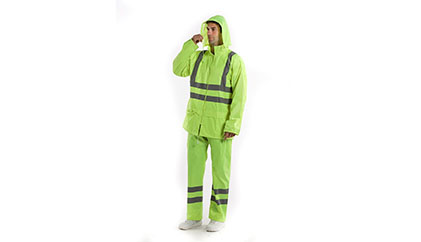
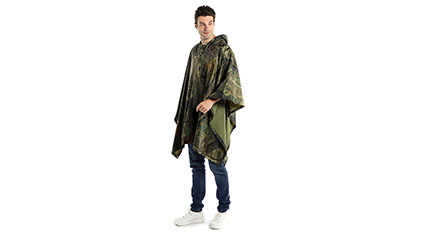
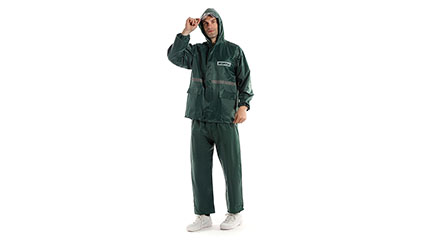
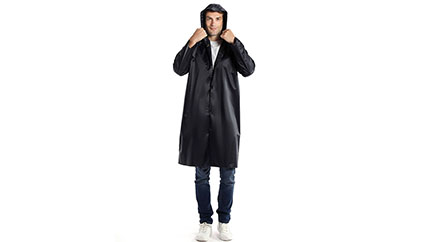
Garment type should follow the job. In a two-piece rain suit, the wearer can strip the jacket off at lunch and keep the trousers on. A split raincoat pulls on over bulky clothing, which suits short trips in and out of the rain. A poncho covers the most ground for the least weight and folds down to a fraction of the space. If that choice is still open, Raincoat, Poncho or Rain Suit? Which One Keeps You Drier? compares how each shape behaves in wet weather.
What the Sampling Stage Should Prove
A sample is not a preview. It is the last cheap moment to find a mistake, so treat it as a test of the specification you intend to repeat at volume.
What to Send with the Sample Request
A custom raincoat manufacturer needs more than a description. Send the material and coating you expect, the size set you will order, the colour reference, the artwork file, the placement and dimensions of that artwork, and the packing format you want. Customization work at Chenyuan Raingear starts from artwork in AI or PSD format, with logo size and position confirmed before production, and listed models quote a sampling window of about seven to ten days. Every input you leave open becomes a decision someone else makes for you.
Checks to Run Before Approving the Sample
Measure the sample against the size chart rather than against the fit you expected. Pour water along the shoulders and seams and watch from the inside. Open and close every zipper, button, and flap. Check the garment weight and the colour in daylight. Then confirm the packing: bag, carton count, and how the pieces are folded. If a detail matters to your customers, it belongs in the approval note, because the approved sample becomes the reference for the bulk run.
Order Details That Carry Into the Repeat Run
The first order tests the factory. The second order tests the record keeping. Sizing, artwork, commercial terms, and colour control decide whether a repeat run repeats anything at all.
Sizing Tolerance Across the Size Run
Get the measurement tolerance in writing, and confirm where it applies. A few centimetres of tolerance on the chest, sleeve and body length still leaves a comfortable garment, but the same tolerance applied to every dimension at once turns a medium into something closer to a small. Record how many pieces per size are measured, and file the approved sample measurements with the production order.
Logo, Label, and Packaging Customization
OEM work starts at 50 pieces and ODM at 300, with tags, wash labels and packaging developed alongside the garment. Artwork arrives in AI or PSD, the logo type and position are confirmed, and batch marking follows. How Can Buyers Plan Custom Rainwear for Branded Workwear Orders? covers the wider planning steps for branded programmes, and this waterproof PVC and polyester hooded raincoat with custom logo print shows the result on a finished adult garment.
Quotation, MOQ, and Acceptance Criteria in Writing
A quotation should be a specification with a price attached. The quotation should state the material and coating, garment weight, size set, packing format, sampling cost, artwork charges, delivery window and the defect criteria that allow or block shipment. Listed adult models quote a minimum order of 1,000 pieces or sets and packing of one piece per bag with 20 pieces or sets per carton on most lines, though carton counts follow the model. Any figure that stays verbal is the figure disputed later.
Colour Consistency on the Second Order
Colour is where repeat orders drift. Dyed and coated fabrics vary slightly between batches, and the difference is easier to prevent than to fix once goods are packed. Keep the approved colour standard, note the lighting it was approved under, and ask the factory to confirm the standard again before the second run starts. A retained sample in your own file is worth more than a photograph, because it does not depend on a screen.
Documents to Request and What Each One Covers
Documentation protects a buyer only when its scope matches the item being purchased. Three kinds of paper come up in rainwear sourcing, and they prove different things. That distinction matters even more in a PPE programme: a test report, certificate, or declaration must match the exact raincoat or rainsuit model and the claim it is meant to support. A REACH report, for example, does not by itself prove PPE performance.
Material and Construction Records
Request the composition, coating, weight and thickness recorded for the model you are buying. The catalogue records one long hooded model at 170T polyester with 0.17 mm PVC and another at PVC with polyester at 0.30 mm thickness, with garment weights of 660 g and 1,075 g. Figures like these give a buyer something to measure against the sample.
Restricted-Substance Test Reports
Under REACH Annex XVII, entry 72 restricts 33 substances classified as carcinogenic, mutagenic, or toxic for reproduction in clothing, textiles, and footwear that contact the skin, and entry 51 limits four phthalates to 0.1% by weight in plasticised material. A test report answers only the question it was commissioned to answer. Report COBO26072990 records pass results for cadmium, phthalates, polycyclic aromatic hydrocarbons, and total fluorine on samples described as a PU rainsuit and a polyester rainsuit, models CY107 and DW02. Those passes belong to those submitted samples, so match any report to the model you are buying instead of reading it as a certificate for a whole catalogue.
Scope Certificates and Transaction Certificates
Recycled-content claims need a second document. A scope certificate confirms what an organisation is certified for, while a transaction certificate covers a specific sale. GRS scope certificate TRC-GRS-351585-00 from TUV Rheinland covers unisex apparel with manufacturing as the certified process at Chenyuan Raingear, issued on 21 July 2026 and valid until 20 July 2027. The scope certificate alone does not prove that a shipment is GRS certified, and the standard requires a valid transaction certificate for recycled material entering the supply chain. Request both, and check that the certificate’s process category matches the work your order needs, particularly when the programme includes workwear produced with GRS-certified material.
What to Confirm Before Committing the First Order
By this point the specification, the sample, and the documents should point at the same product. The last step is confirming that the factory can deliver that product on time.
Capacity Against Your Volume and Lead Time
Return to capacity with your own numbers. An order of 30,000 pieces against a documented 150,000 a month looks simple on paper, but the schedule depends on what else is on the line. Ask which line is assigned, when materials are reserved, and how holidays affect the timeline. Comparing raincoat manufacturers in China is a scheduling exercise as much as a price exercise, and a factory that answers with dates is more useful than one that answers with reassurance.
First-Article and Defect Sign-Off
Agree on what happens before the full run ships. Many buyers ask for a first article from the actual production line rather than a new sample, and for inspection notes at defined points. Define defect criteria in the same document as the acceptance terms, and name who may approve a deviation. Confirm the packing list, carton labelling, and shipping marks here too, because specifying them after production costs more than deciding them before it.
Conclusion
The manufacturer that fits a bulk order can answer for every stage between fabric cutting and the shipping carton: the material and construction behind the specification, how size runs and repeat colours are controlled, the customization and sampling limits in writing, and documents whose scope matches the item being bought. A PPE rainsuit programme follows the same logic: match the garment, sample, certificate, and shipment records before scaling the order. Send the specification, artwork, target quantity, and packing requirement to Chenyuan Raingear in one pass for a China raincoat order, and ask for a sample plan built around the two-piece rain suit series or whichever garment family you are buying.
FAQs
Q1:How do I compare raincoat manufacturers in China before ordering samples?
A1:Hand every supplier the same written specification and ask for the same material, coating, weight, size set and packing. Raincoat manufacturers in China look alike on a directory page, so identical inputs are what expose which quotation is genuinely cheaper and which one quietly left something out. Then ask whether sealing and inspection happen in-house.
Q2:Which documents prove an order is compliant, and which only cover a tested sample?
A2:A restricted-substance test report proves the results for the samples submitted for testing, so it must be matched to the model you are buying. A scope certificate shows what a facility is certified for, while a transaction certificate covers a specific shipment. For recycled content, the shipment-level document is the one that matters. For PPE raincoats or PPE rainsuits, keep any performance or compliance claim separate from a REACH report and confirm the exact model, document type, and test scope the buyer requires.
Q3:What should be fixed before a custom raincoat sample is made?
A3:Fix the fabric and coating, the size set, the colour reference, the artwork file and logo placement, and the packing format. A custom raincoat manufacturer can only build a sample that means something if those inputs are already decided, and the approved sample then becomes the reference for measurement, seam sealing, closures, and colour on later runs.
 E-mail
 Whatsapp
 Leave Message
 top
top