



Table of Contents
Related news

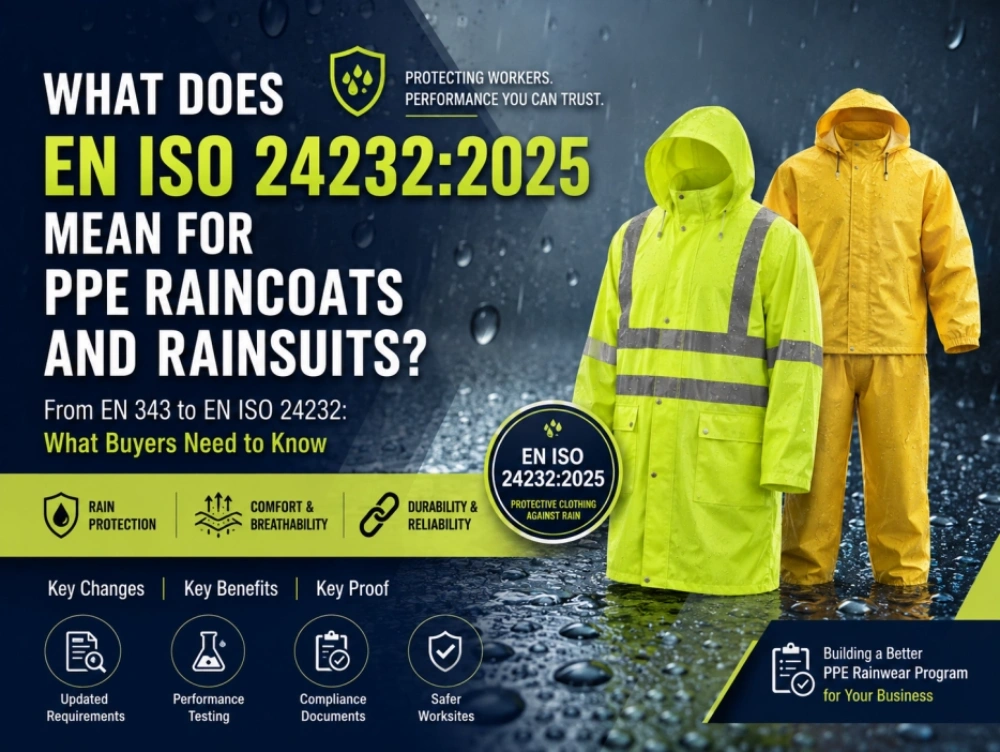
What Does EN ISO 24232:2025 Mean for PPE Raincoats and Rainsuits?
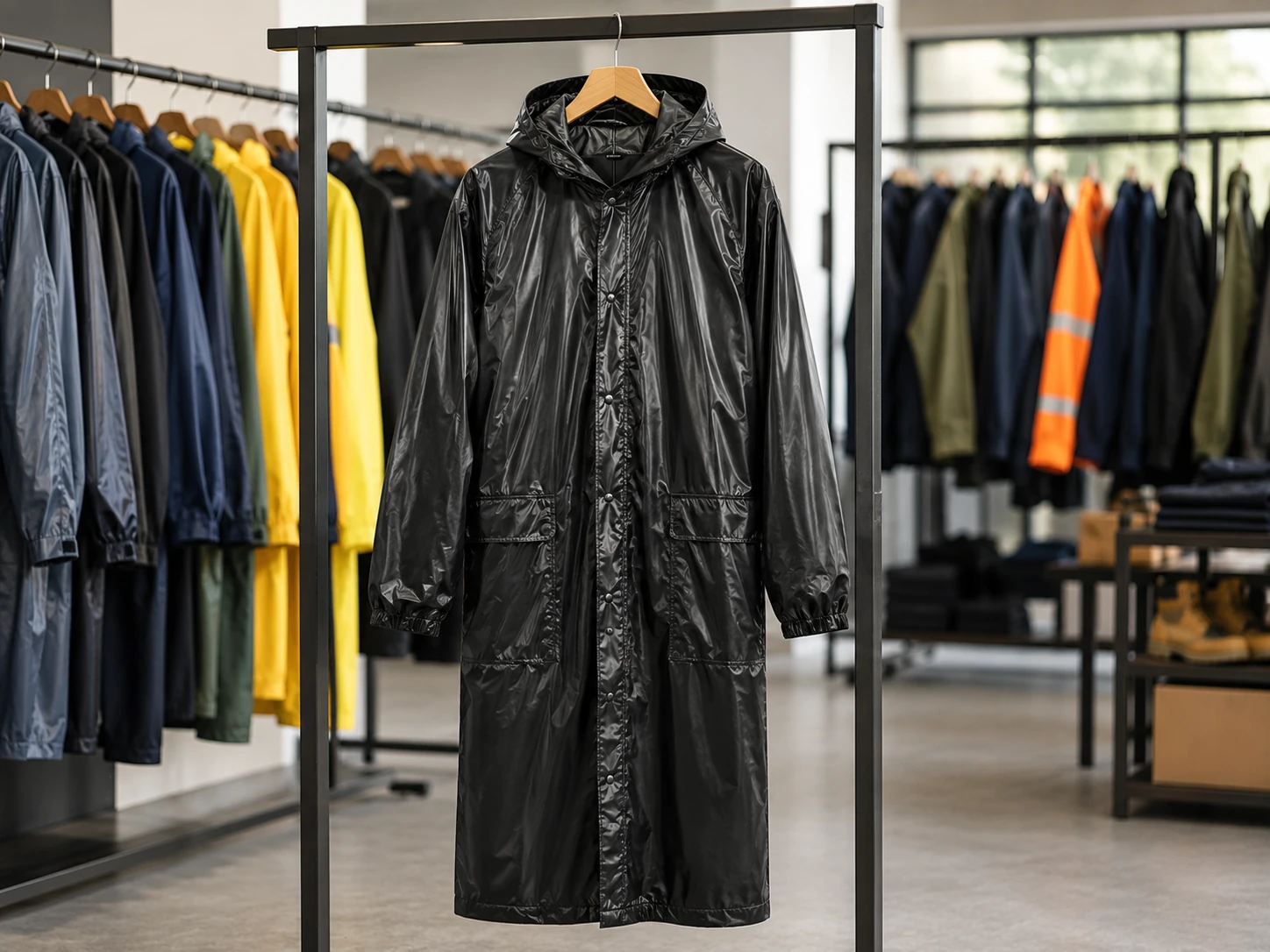
A PPE raincoat is not simply a heavier version of everyday rainwear. For construction crews, sanitation workers, maintenance teams, utility staff, and other people who work outside in wet weather, rain protection becomes part of the workwear specification. Buyers need to think about how long the garment will be worn, how much the worker moves, where water can enter, and what evidence supports the claimed performance.
That is why EN ISO 24232 matters. EN ISO 24232:2025 is the European adoption of ISO 24232:2024 for protective clothing against rain. It succeeds the EN 343 framework used for many European rain-protection specifications. For buyers of PPE raincoats and PPE rainsuits, the change is a good reason to review old RFQs instead of simply replacing “EN 343” with a new number. The standard is one part of the decision; garment construction, material compliance, supplier traceability, and the hazards of the actual job still need separate attention.
Why Does EN ISO 24232 Matter for PPE Rainwear Buyers?
EN ISO 24232 covers materials and ready-made garments intended to protect against precipitation, including rain and snowflakes, as well as fog and ground humidity.
That sounds straightforward, but the scope matters. It does not cover every form of water exposure. Protection against water splashes and waves falls outside its scope. It also does not turn a rain garment into protection against chemicals, flame, electrical hazards, or every visibility risk found on a worksite.
For a PPE raincoat buyer, the practical question is therefore not simply “Does it meet a rain standard?” The question is whether the standard matches the exposure the worker actually faces.
What Changed After EN 343?
EN 343:2019 was familiar to European protective-rainwear buyers. EN ISO 24232:2025 brings the subject into an EN ISO framework based on ISO 24232:2024.
The newer standard updates references and revises parts of the requirements and test structure, including the treatment of water penetration resistance and the organization of pretreatment and testing.
This means existing product files should be checked carefully. An older EN 343 report may still contain useful performance information, but buyers preparing a new European PPE rainwear order should confirm which current standard and national adoption apply to that project.
Simply editing an RFQ from “EN 343” to “EN ISO 24232” without checking the test evidence can leave important gaps.
What Is an EN ISO Standard, and What Does EN ISO Mean?
An ISO standard is developed internationally. An EN standard is adopted within the European standards system. When an ISO document is adopted as a European Standard, it can carry the EN ISO designation.
The EN ISO meaning becomes more practical when buyers start reviewing reports from different markets. The same core standard may appear with a national prefix, such as BS EN ISO in the United Kingdom or DIN EN ISO in Germany.
For purchasing teams asking what is an EN ISO standard in practical terms, the important point is consistency. The RFQ, sample approval, laboratory report, garment marking, and supplier documents should refer to the correct standard version rather than a mixture of old and new references.
The standard number alone is not proof that every product from a supplier has been tested to it.
What Should a PPE Raincoat or PPE Rainsuit Actually Prove?
A professional rainwear specification should answer two different questions.
First, can the material resist rain under the required test conditions?
Second, does the finished garment remain practical when worn during work?
A fabric can perform well while the finished PPE rainsuit still has weak points around the seams, front closure, hood, cuffs, waistband, pockets, or trouser openings.
Why Do Water Resistance and Moisture Management Both Matter?
A road worker directing traffic and a gate attendant standing under a shelter may wear rainwear very differently.
The road worker may walk, bend, lift equipment, and generate considerable body heat. The gate attendant may remain relatively still for long periods. The outer rain protection could look similar, but the wearer experience is not.
EN ISO 24232 addresses rain-protection performance, including water penetration resistance and water-vapour resistance. Buyers should consider both instead of specifying “waterproof” as a single yes-or-no requirement.
The garment also needs enough room for whatever is worn underneath. A PPE rainsuit tested on a model wearing a T-shirt may fit very differently over winter workwear or another protective layer.
Why Is Seam Construction Important?
Most PPE rainsuits are assembled from several cut panels. Sewing creates openings through a waterproof or coated material, which means seam treatment becomes part of the finished construction.
Chenyuan’s production process for rainsuits and raincoats includes purchasing, cutting, sewing, sealing, assembly, inspection, and packing. Sealing therefore sits between sewing and final assembly rather than being treated as a cosmetic finishing step.
For B2B buyers, this is worth checking on the approved sample. Inspect the shoulder seams, hood attachment, crotch area, inside-leg seams, pocket construction, and front closure. These are often more revealing than simply touching the fabric.
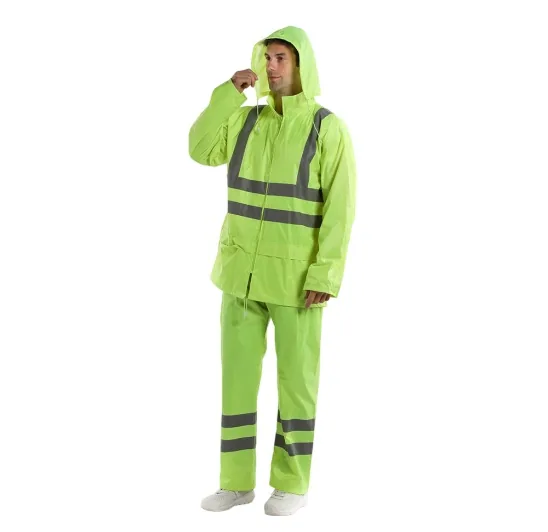
Buyers comparing different occupational formats can review PPE rainsuit options covering two-piece, one-piece, PU, polyester/PVC, Oxford, and reflective constructions.
How Should PPE Rainwear Change With the Job?
There is no single PPE raincoat that makes sense for every outdoor occupation. The garment format should follow the worker’s movement and exposure.
| Work situation | Rainwear format to consider | Main points to check |
| Construction and site maintenance | Two-piece PPE rainsuit | Bending coverage, seams, cuffs, visibility requirements |
| Road and utility work | Rain suit or jacket-trouser set | Rain protection plus separately defined hi-vis requirements |
| Sanitation and cleaning | Lightweight rainsuit | Mobility, easy-clean surface, cuffs, repeated wear |
| Security and gate inspection | Long PPE raincoat | Quick dressing, lower-body coverage, layering space |
| Yard and logistics work | Raincoat or two-piece set | Movement, vehicle visibility, hood and pocket access |
| Wet environments with spray or waves | Specialist protective clothing | EN ISO 24232 alone may not cover the exposure |
When Is a Two-Piece PPE Rainsuit More Practical?
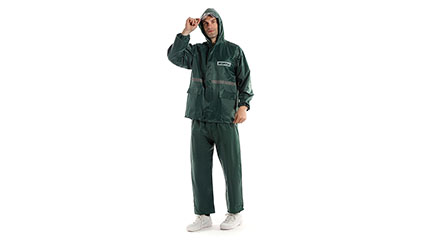
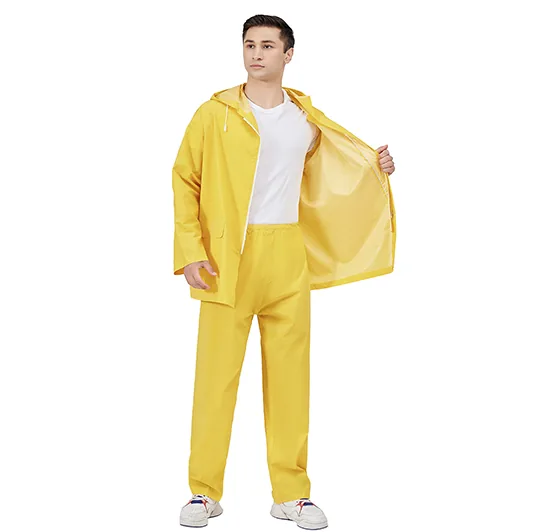
A jacket-and-trouser set makes sense when the worker bends frequently or remains outside through sustained rain. The trousers protect areas that a coat may leave exposed, while separate pieces can also make sizing and changing easier.
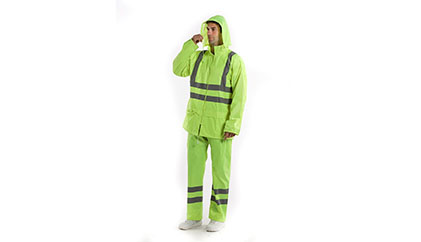
Chenyuan’s industrial safety raincoat with pants is a polyester/PVC two-piece workwear example. The model uses jacket-and-trouser construction and is available in S through XXXL, with customized logo support.
The product format is relevant to occupational use, but buyers should still match any required PPE standard to the exact order and testing route rather than assuming that a workwear-style garment automatically carries every possible certification.
When Can a PPE Raincoat Be the Better Choice?
For workers who move between indoor and outdoor areas, a long raincoat can be quicker to put on and remove. It may also be adequate when exposure is mainly vertical rainfall rather than continuous contact with wet surfaces.
The trade-off is lower-body protection. If workers kneel, bend, climb, or work beside wet equipment, trousers may provide a more complete system.
This is why job analysis should come before fabric selection.
Which Documents Should PPE Rainwear Buyers Check?
Protective rainwear orders often collect several certificates and test reports. The mistake is treating them as if they all prove the same thing.
They do not.
| Document or test | What it helps verify | What it does not prove by itself |
| EN ISO 24232 evidence | Rain-protection performance within the standard’s scope | Chemical, flame, electrical, or all hi-vis hazards |
| REACH testing | Restricted substance compliance for tested materials | Waterproof PPE performance |
| PFAS screening | Presence or non-detection of specified fluorinated substances | Overall rainwear certification |
| GRS documentation | Recycled-material scope and traceability | Performance of every delivered rainsuit |
| Factory audit | Production and management controls | Performance class of a specific product |
| Approved sample | Construction, fit, materials, trims | Automatic consistency of future bulk lots |
What Can REACH Testing Tell a PPE Buyer?
Material compliance matters because a PPE rainsuit can contain coated fabric, plastic zipper components, metal hardware, printing, and other materials.
For selected Chenyuan rainsuit samples CY107 and DW02, the submitted PU rainsuit and polyester rainsuit materials were tested for cadmium under REACH Annex XVII Entry 23, phthalates under Entries 51 and 52, and PAHs under Entry 50. The tested samples received PASS conclusions for those items.
The same report also included total fluorine screening. The tested materials returned results below the stated method detection limit.
That gives a buyer useful material-level information, but it should not be presented as evidence that the garments meet EN ISO 24232. Rain performance and restricted-substance testing answer different questions.
Where Does PFAS Screening Fit?
PFAS requirements are becoming a separate sourcing discussion for many textile and coated-fabric programs.
For example, a 210T polyester taffeta polka-dot printed fabric in the available material testing set was assessed under EN 17681-1:2025. The listed PFAS substances were reported as not detected at the stated detection limits.
The careful wording matters. “Not detected” under a defined test method is more precise than simply calling a material “PFAS-free.”
For PPE raincoat programs using printed or customized fabrics, buyers should decide before sampling whether substance screening is required and which components need to be tested.
Can Recycled Materials Be Used in PPE Raincoats and Rainsuits?
Recycled content and protective performance are separate specification lines, but they can exist in the same sourcing program.
Chenyuan’s current GRS scope covers both Raincoats and Rainsuits. The certified product scope includes recycled post-consumer polyester combined with PVC, with manufacturing included under the certified process scope.
That is useful for customers building rainwear programs with recycled-material requirements.
There is an important procurement detail, however. A GRS scope certificate does not mean that every raincoat shipped by the factory is automatically a GRS-certified product. Specific certified goods need the appropriate transaction documentation covering the delivery.
That distinction can prevent a common private-label problem: marketing claims are approved before the buyer has confirmed which specific order is covered.
The 2026 GRS audit also reviewed areas such as incoming transaction documentation, recycled-material stock records, production batch records, finished-product stock records, supplier information, and volume reconciliation. These controls become particularly useful when buyers need traceability behind a recycled-content claim.
How Can a Manufacturer Reduce PPE Rainwear Approval Problems?
The best time to solve a PPE raincoat problem is before bulk cutting starts.
A buyer should freeze the major details in a pre-production sample: fabric, coating, color, hood, front closure, seam treatment, cuff design, trouser construction, reflective elements where required, size grading, labels, and packaging.
Chenyuan’s audited production flow covers raincoats and rainsuits from material purchasing through cutting, sewing, sealing, assembly, inspection, and packing. That gives workwear buyers several checkpoints where an approved construction can be controlled during production.
For teams sourcing occupational rain protection, Chenyuan also provides workplace rainwear solutions for work scenarios such as construction, sanitation, and other outdoor occupations.
A useful PPE rainwear RFQ should therefore include:
-
intended occupation and work environment;
-
target country or market;
-
required standard and edition;
-
raincoat, one-piece suit, or two-piece rainsuit format;
-
material and coating preference;
-
required test reports;
-
size range and layering allowance;
-
visibility requirements where applicable;
-
logo and label details;
-
material-compliance requirements such as REACH or PFAS screening;
-
recycled-content requirements where applicable;
-
pre-production and bulk-inspection expectations.
Once those points are clear, buyers can discuss a PPE rainwear specification with Chenyuan before sampling rather than trying to resolve compliance questions after production has started.
Conclusion
EN ISO 24232:2025 gives PPE raincoat and PPE rainsuit buyers an updated framework for rain-protection performance, but the standard should not be used as a shortcut for the whole purchasing decision. Start with the worker’s real exposure. Then check garment format, water protection, seam construction, movement, fit, and the exact test evidence required for the target market.
For professional rainwear orders, supporting documentation matters as well. REACH testing, PFAS screening, GRS traceability, factory process controls, and approved production samples each answer a different sourcing question. Keeping those roles separate makes the specification clearer and reduces the risk of buying a garment that looks suitable for work but lacks the evidence or construction the project actually needs.
FAQs
Q1: Does EN ISO 24232:2025 replace EN 343 for PPE rainwear?
A1: EN ISO 24232:2025 is the European adoption of ISO 24232:2024, and national versions such as the current British and German standards have replaced their previous EN 343:2019 editions. Buyers should confirm the applicable adoption for their target market when preparing a new PPE rainwear specification.
Q2: Does a PPE rainsuit with reflective tape automatically meet hi-vis PPE requirements?
A2: No. Rain protection and high-visibility protection are separate requirements. Reflective tape can improve visibility, but buyers requiring certified high-visibility PPE should specify and verify the applicable visibility standard separately.
Q3: Are REACH, PFAS, or GRS documents enough to prove EN ISO 24232 compliance?
A3: No. REACH and PFAS testing concern material substances, while GRS concerns recycled-content certification and traceability. They can strengthen a PPE rainwear procurement file, but they do not replace the rain-protection performance evidence required for EN ISO 24232.
 E-mail
 Whatsapp
 Leave Message
 top
top