





Table of Contents
Related news

What Does a GRS Transaction Certificate Prove for a Rainwear Order?
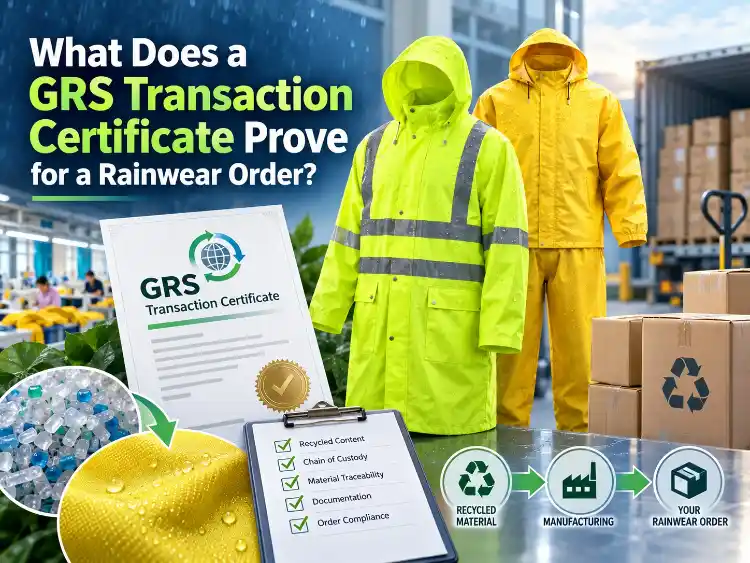
A GRS transaction certificate proves that a defined quantity of recycled material in a specific sale is covered by the Global Recycled Standard chain of custody. It does not prove that every raincoat on your order is certified simply because your supplier holds a certificate for its facility. Those are two different documents, and the difference matters most in the week before shipment, when a buyer has already committed to a claim.
Understanding what a transaction certificate covers, how it relates to the scope certificate behind it, and which details have to match your purchase order keeps a recycled-content claim defensible long after the goods arrive.
What a Transaction Certificate Actually Covers
The transaction certificate (TC) is issued for a sale. It records that a specific quantity of material moved from one certified organisation to another under the standard’s chain of custody, which is why it is the document a buyer needs when the question is about delivered goods rather than about a supplier’s capability.
The Shipment, Not the Facility
A buyer who starts from what is a GRS certificate usually needs the document behind the acronym rather than the definition. Facility-level certification answers whether an organisation is audited and for what. A transaction certificate answers a narrower question: whether this batch of material, in this sale, is covered. That is why a certificate issued to a yarn spinner or a fabric mill cannot simply be filed as proof for a finished raincoat order — the chain between the two has to be intact, and the transaction certificate is what records each link.
What Appears on the Document
A usable document carries identifying information that lets a buyer connect it to an order: the issuing certification body, the certified organisation that sold the material, the buyer or receiving organisation, the product description, the quantity, the standard and content claim, and the issue date. Buyers who read only the logo and the validity date miss the fields that decide whether the certificate belongs in their file at all. Textile Exchange publishes a public route for authenticating a transaction certificate, so the document can be checked against the standard owner’s records rather than trusted as a scan.
Scope Certificate and Transaction Certificate Do Different Jobs
Both documents come from the same standard, which is exactly why they get confused. Textile Exchange, which owns the Global Recycled Standard and the Content Claim Standard beneath it, treats the scope certificate as confirmation of an organisation’s conformity and the transaction certificate as coverage of a specific sale; a due-diligence file needs both, because each answers a question the other cannot.
What the Scope Certificate Certifies
A scope certificate records that a named facility has been audited and found in conformity for a defined standard version, product category and process category, and it states how long that conformity lasts. A Global Recycled Standard certificate at facility level is therefore only as useful as the scope printed on it. Chenyuan Raingear holds a GRS scope certificate for unisex apparel with manufacturing as the certified process, issued by TÜV Rheinland under version 4.0 of the standard and valid until 20 July 2027. Read as a facility document, that certificate says what the organisation may produce under the standard — not which shipment was sold under it.
What the Transaction Certificate Adds
The shipment-level document adds the sale. It ties a volume to a buyer, to a seller and to a standard, so it can support a claim on goods that have actually changed hands. The scope certificate’s own limitation language makes the same point from the other direction: it states that the certificate provides no proof that goods delivered by its holder are certified, and that proof for delivered goods comes from a valid transaction certificate.
How the Certificate Chain Reaches a Rainwear Order
A raincoat is assembled from more than one input, and the certified content has to arrive through a chain rather than through a single purchase. Where that chain enters the garment being ordered, and which processes the manufacturer’s own certification covers, are the questions a buyer has to answer.
Where Certified Material Enters the Garment
Certified content normally enters at the material stage — the fibre or fabric that carries the recycled claim — and then travels through the suppliers who handle it. The garment manufacturer is one link in that chain, not the origin of the claim. This is why the material and the standard should be named in the specification itself: a buyer who writes “recycled polyester shell” without naming the standard and the content percentage leaves the chain undefined until the documents arrive, when it is late to correct.
How the Factory’s Audited Process Scope Bounds the Claim
The manufacturer’s own certification covers listed processes, and the claim only holds for work that falls inside them. The GRS audit record lists the production flow as purchasing, cutting, sewing, sealing, assembly, inspection, packing and selling. When a buyer reads a scope certificate, the product category and process category are the fields to compare against the actual order — a claim cannot be stretched to a process or product group the certificate does not cover. Details of that audited scope are published alongside the company’s certificate materials in its GRS audit report.
Matching the Certificate to Your Purchase Order
This is the step buyers most often skip, and it is where a certificate that looks convincing turns out to belong to someone else’s order. The check is administrative rather than technical: read the document against the purchase order, line by line.
Entity, Product and Volume
Start with names. The seller named on the transaction certificate should be the organisation actually invoicing the certified material, and the buyer should be the entity taking ownership. Then compare the product description with the material you specified, and the volume with the quantity you ordered. A certificate covering a different material grade, or a volume far larger than your order, may still be genuine — but it is evidence for another transaction, not for yours, unless the certification scheme’s own rules allow a volume to be allocated across several deliveries.
Standard, Claim Percentage and Date
Next, check what is being claimed and when. The standard and version should match the claim you intend to publish, the content percentage should be at least what your specification promises, and the issue date should sit logically within the order timeline rather than months before the material was produced. When a branded programme carries several certified components, sequencing the order requirements before sampling keeps the certificate checklist attached to the garment specification instead of the invoice.
GRS certificate verification should also identify which transaction system produced the record. The current Textile Exchange system supports conventional transaction certificates alongside eTransactions for GRS and RCS certified material. A paper TC should be authenticated against the issuing certification body’s system or dTrackit, while an eTransaction is authenticated in eTrackit. Both mechanisms are based on the same chain-of-custody criteria, and conventional TCs have not been phased out. For a buyer, the practical rule is simple: identify the mechanism used for the order, then verify the record against the corresponding source of truth before relying on the recycled-content claim.
What the Documents Do Not Prove
Neither certificate is a performance document. A Global Recycled Standard certificate says nothing about waterproofness, seam strength, abrasion resistance or protective classification, and it cannot substitute for the test reports and standards a workwear buyer would normally request — the PPE standards buyers use when choosing rainwear for contractors sit in a separate evidence file entirely.
In the same way, a restricted-substance test report covers the items tested and the scope printed on it. Chenyuan Raingear’s REACH Annex XVII report records pass results for cadmium, phthalates, PAHs and total fluorine on the submitted PU and polyester rainsuit samples, models CY107 and DW02 — samples, not a catalogue-wide guarantee. Keeping content claims and performance evidence in separate folders, and asking for the right document for each, prevents a well-documented order from being over-sold internally.
What to Request and When
Requests work best when they are attached to an order milestone rather than sent as a general enquiry.
Before the order is placed, confirm in writing which standard and content percentage will be claimed, which entity will appear as the seller, and that the material will come with a transaction certificate. During sampling and pre-production, ask whether the certificate is issued per shipment or per delivery, and record the invoice or delivery reference it will follow. At shipment, request the transaction certificate together with the scope certificate that covers the facility, and keep both with the specification, the approved sample record and the inspection notes. For a programme that includes protective garments with their own certified materials, the workwear range built with certified material shows how those documentation requirements sit alongside the garment specification.
Conclusion
A GRS transaction certificate is the document that ties a recycled-content claim to a specific sale, and for a rainwear order it belongs in the order file rather than in a sustainability folder. Confirm the standard and content claim before ordering, check that the entity, product, volume and date on the certificate match the purchase order, and keep the scope certificate beside it so both halves of the chain are documented. Make GRS certificate verification part of shipment release rather than an afterthought, and treat any Global Recycled Standard certificate as evidence only for the scope or transaction it actually covers. Those questions belong in the quotation stage rather than the delivery stage: an answer that stays verbal is worth asking again. Chenyuan Raingear publishes its GRS scope certificate and the audit record for the processes it covers, which gives a buyer a concrete starting point for that check.
FAQs
Q1: What is the difference between a GRS scope certificate and a transaction certificate?
A1: A scope certificate covers an organisation and states the standard, product and process categories it is certified for. A Transaction Certificate (TC) covers a specific sale of certified material, so it names the parties and the volume involved. Buyers typically need both: the first shows that the facility is certified, and the second shows that the material they bought is part of the certified chain.
Q2: Does a supplier’s GRS certificate cover my rainwear order automatically?
A2: No. A facility certificate does not transfer to a shipment by itself. Unless the material you buy is covered by a transaction certificate for that sale, the claim is not documented for your order — which is why the requirement is best agreed in writing before production starts.
Q3: How do I check a transaction certificate against my purchase order?
A3: Compare the names, product description, volume, standard and claim percentage on the document with the purchase order, then confirm the issue timing against the shipment. Asking what is a GRS certificate in the abstract is less useful than asking which document will cover this order, and the manufacturer’s scope certificate should cover the product and process the order actually uses.
 E-mail
 Whatsapp
 Leave Message
 top
top