

Table of Contents
Related news
PPE Raincoat Buyer’s Guide: How to Choose Materials, Seams, and Fit for Wet Work
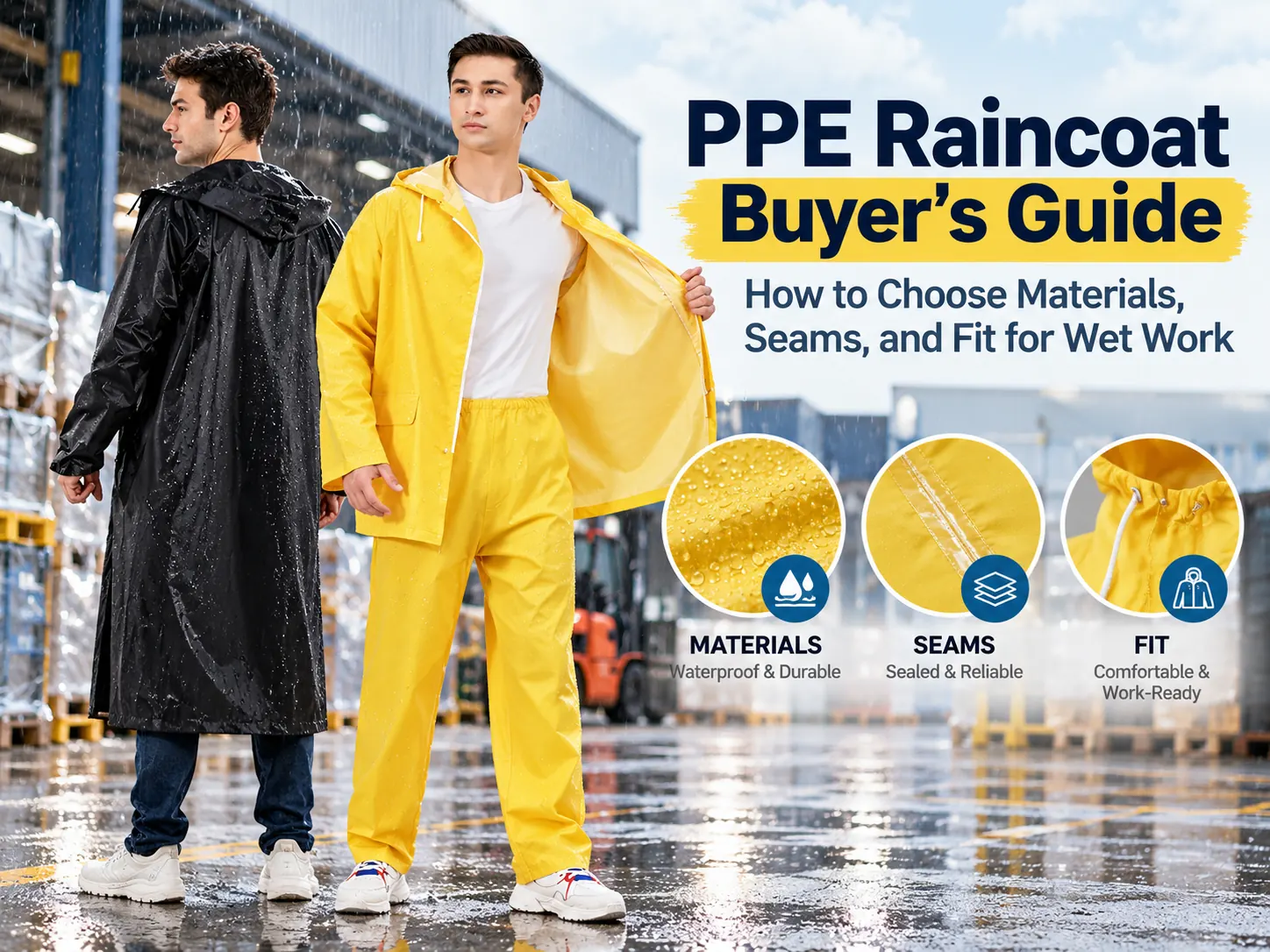
A PPE raincoat can look simple on a quotation: one garment, one material code, one price. In wet work, the differences that decide whether a crew stays dry usually sit below the product name. A long PVC coat, a PU-coated two-piece set, and an Oxford waterproof workwear shell may all be described as waterproof, yet they solve different problems.
This guide is for importers, distributors, and safety buyers who need to specify a protective rainwear program around the job and the layers beneath the raincoat. It focuses on material, coating, seams, closures, coverage, and fit. It does not rank fabrics in the abstract; it explains what each choice changes for the wearer.
Start With the Work, Not the Product Name
Rain Exposure and Movement
The first question is not “Which fabric is waterproof?” It is “What is the worker doing in the rain?” A worker who moves between a vehicle and a building may need a quick long coat. A worker who kneels, climbs, or stays outside for a full shift may need a two-piece rainsuit with trousers that cover the waist, crotch, and lower legs.
Exposure also changes the specification. Vertical rain is not the same as spray from a pressure washer, water splashing from a wet surface, or rain combined with wind. If the garment is expected to protect against a chemical, flame, arc, or visibility hazard as well as rain, the raincoat becomes part of a broader PPE requirement. In that case, waterproofness is only one performance question. The guide to PPE standards for contractors shows which requirements apply to the job.
Compatibility With Other PPE
A PPE raincoat is normally an outer layer. It has to fit over the workwear, thermal layers, and other PPE the worker already wears. A jacket that fits over a T-shirt may not fit over winter workwear, a hi-vis vest, or a harness.
Check the interfaces before comparing prices:
- Can the worker raise both arms, bend, kneel, and climb without the coat pulling?
- Does the hood work with the hard hat and face protection?
- Do the cuffs fit over gloves without opening a gap?
- Does the front closure stay covered when the worker moves?
- Does the garment interfere with the visibility system already in use?
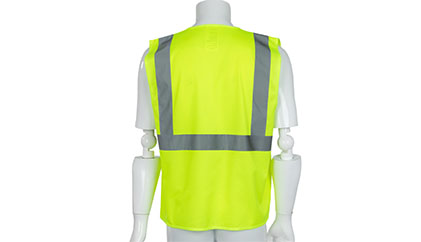
Visibility and waterproofness are separate performance questions. A bright colour may help, but it does not by itself establish compliance with a visibility standard. Buyers should keep each claim attached to the relevant test evidence.
Compare Materials Without Treating Them as a Ranking
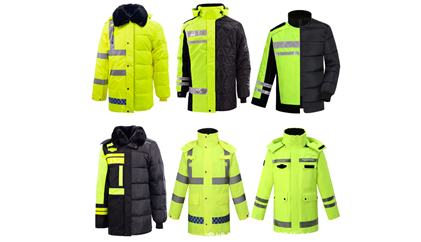
The available Chenyuan Raingear materials include PVC, polyester/PVC, PU-coated fabrics, Oxford cloth, EVA, jacquard and other constructions. Those names describe families, not complete specifications. Two garments can use the same family name and still differ in fabric weight, coating, surface finish, seam treatment, and care requirements. Industrial rain gear includes coats, jackets, trousers, bibs, and two-piece suits; a product name alone does not tell the buyer which format the job needs.
PVC and Polyester/PVC
PVC and polyester/PVC are two material families in the range. The material name does not tell you how the finished garment will perform: coating weight, fabric construction, seams, closures, and the test evidence for the exact model all affect the result. For that reason, a performance claim should stay attached to the model and its approved technical evidence rather than being extended to every garment that shares the material name.
For a wet-work programme, ask what the worker will notice after two hours: weight, stiffness, heat build-up, movement, and ease of cleaning. Those are practical selection variables, not marketing details.
PU-Coated and Breathable Options
PU-coated fabric is another option in the range. The two-piece PU rainsuit is one example of how the material is used in a two-piece format, but “PU” alone does not prove better breathability, durability, or waterproof performance. Buyers still need the exact fabric, coating, weight, colour, size set, and test scope for the model being quoted.
If breathability is important, ask how moisture vapour is managed and how the barrier is protected. EN ISO 24232 treats water penetration resistance and water-vapour resistance as separate performance questions.
Oxford and Other Woven Options
Oxford cloth also appears in the material list. It is a base fabric description, not a complete waterproof specification. The coating, finish, fabric weight, and seam construction determine how the finished garment behaves.
The useful comparison is not “PVC versus PU versus Oxford” in general. It is which complete construction matches the exposure, movement, cleaning, and storage routine of the crew.
What “Waterproof” Must Mean on the Garment
A waterproof fabric test is not the same as a waterproof finished garment. Water can pass through a seam, closure, hood attachment, cuff, pocket, or trouser opening even when the main fabric performs well.
Coating, Membrane, and Face Fabric
The outer face fabric, the coating or membrane, and any inner layer have different jobs. The buyer should know which part provides the barrier, how it is protected from abrasion, and what the care label allows.
A coating can stiffen, crack, peel, or delaminate after repeated use. Those changes belong in the inspection routine, not only in the purchasing comparison.
Seams, Closures, Hood, and Cuffs
Sewing creates holes through the material. Seam sealing, tape, or welding closes those paths, which is why seam construction belongs in the specification. Chenyuan Raingear’s production flow includes cutting, sewing, sealing, assembly, inspection, and packing; sealing is a separate production step rather than a cosmetic finish.
Inspect the finished garment at the points that move and flex:
- shoulder and arm seams
- hood attachment and adjustment
- front closure and storm flap
- cuffs and sleeve openings
- waist, pockets, and any drawcords
- crotch, inside leg, and ankle openings on a two-piece suit
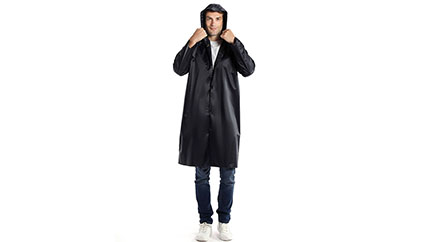
The long hooded PVC industrial raincoat shows how the coat format handles upper-body coverage. A two-piece PU rainsuit shows the alternative when the job needs lower-body movement and coverage.
What “Waterproof” Does Not Prove
A raincoat described as waterproof does not automatically provide chemical, flame, arc, or high-visibility protection. Those are separate hazards with separate performance requirements. If the job includes them, the buyer should verify the relevant standard and the evidence for the exact model.
Keep every claim tied to the model, material, construction, and test scope. A generic certificate for a factory or a fabric family is not a substitute for the garment’s own evidence.
Choose the Garment Format for the Job
Long Raincoat vs Two-Piece Rainsuit
A long raincoat is quick to put on and remove, covers more of the upper legs, and can suit stationary work, inspections, gate duty, or movement between indoor and outdoor areas. It may be enough when the main exposure is vertical rain.
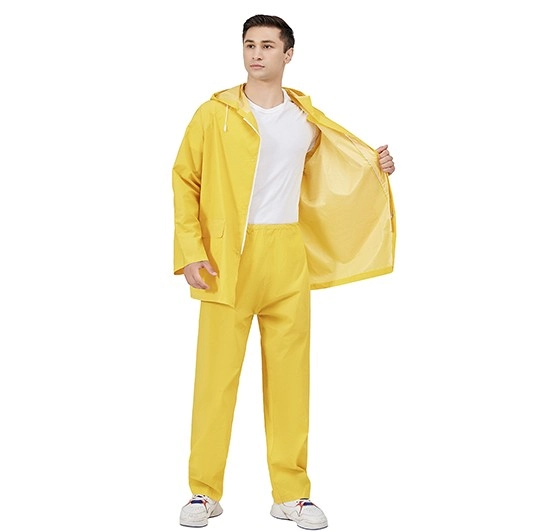
A two-piece rainsuit separates the jacket and trousers. It gives the worker more freedom to bend and kneel, protects the waist and lower body more completely, and allows a damaged component to be replaced without discarding the whole set. It is often the more practical format for construction, maintenance, sanitation, and sustained outdoor work.
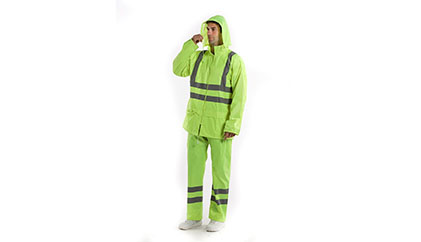
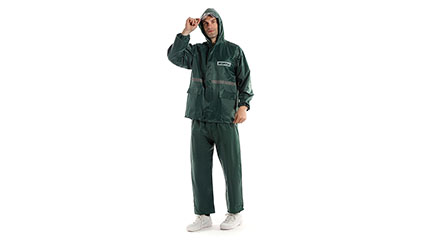
Two-piece rainsuits separate the jacket and trousers so the worker can bend, kneel, and move while keeping the waist and lower body covered. Choose the format from the job, not from the product name alone. Compare the two-piece rainsuit range to see the available constructions.
Trousers, Bibs, and Lower-Body Coverage
If workers kneel on wet ground, climb, or work beside splashing water, a coat alone may leave the lower body exposed. Check the waist, crotch, inside leg, knee area, and ankle opening. The trousers should fit over the boots and the workwear without creating a gap when the worker moves.
A longer coat can improve coverage, but it cannot replace trousers in every task. The right answer depends on the movement and the exposure.
Fit Over Workwear and Other PPE
Fit should be tested over the complete layer stack, not measured against the body alone. A raincoat that is too tight can restrict movement, pull at the shoulders, or expose the lower back when the worker bends. A raincoat that is too loose can catch on equipment or allow water to enter at the cuffs and hem.
The sample review should include the actual workwear, thermal layer, gloves, hard hat, footwear, and visibility equipment. Check the shoulder, sleeve, chest, waist, hood, and leg movement. The worker should be able to put the garment on and take it off without help in the conditions expected on site.
Selected Chenyuan Raingear styles list sizes from S to XXXL and support custom sizing. Buyers should confirm the size set for the exact style and test the approved size on the workers who will wear it.
Approve a Sample That Represents the Order
A sample is only useful when it represents the production order. The approved sample should carry the exact fabric and coating, colour reference, seam treatment, closure, hood, cuff, size set, logo placement, labels, and packing format.
The sample should be tested in the same layer stack the workers will use. Record what was approved, keep a retained sample, and refer to it when the repeat order is placed.
Chenyuan Raingear’s quality process begins with material approval and a pre-production sample, continues with online checks during production, and ends with an inspection report after packing. The quality process explains how production is controlled. For order planning, Chenyuan Raingear documents OEM support from 50 pieces and ODM support from 300 pieces, with sampling typically taking 7-10 days and production commonly 30-45 days after order confirmation. Those figures should be confirmed for the exact style and current schedule.
What to Verify Before Bulk Production
Before production starts, the specification should be written in one place:
- fabric, coating, and colour
- garment format and size set
- seam treatment, closures, hood, and cuffs
- logo, label, and packing requirements
- performance or compliance evidence for the exact model
- inspection points and final report
- approved sample reference
The buyer should also confirm how the garment will be cleaned and stored. A care label is part of the specification because the wrong cleaning method can damage a coating or seam long before the fabric wears out.
Conclusion
Choose a PPE raincoat by the work, not by a single material name. Match the format to movement and coverage, compare complete constructions rather than polymer labels, verify the seams and closures that make the finished garment waterproof, and test the fit over the actual workwear and PPE. Then approve a sample that represents production and keep the specification, evidence, and care instructions together.
For a wet-work programme, review the two-piece rainsuit range and confirm the exact material, construction, and size set for the crew.
FAQs
Q1: Is PVC better than PU for a PPE raincoat?
A1: Neither material is universally better. PVC, polyester/PVC, and PU-coated fabric are all available in the range. The right choice depends on the exposure, movement, breathability, weight, care routine, and the approved evidence for the exact model. Do not choose by polymer name alone.
Q2: Is a raincoat waterproof if the fabric passes a waterproof test?
A2: Not necessarily. The finished garment also depends on seam sealing, closures, hood, cuffs, and construction. Ask how the seams are treated and inspect the complete garment for the way it will be used.
Q3: How should I size a PPE raincoat over workwear?
A3: Size it over the actual layer stack. Test the sample with the workwear, thermal layers, gloves, hard hat, and other PPE that will be worn together. Movement, coverage, and comfort matter as much as the size label.
 E-mail
 Whatsapp
 Leave Message
 top
top